This is a bit cheesy and a few years old judging from some views where you can see the QV complex still under construction, but it is always interesting to hear an outsider's take on Melbourne architecture.

Thursday, August 26, 2010


Sunday, August 15, 2010
Look ma! I'm in the paper.
This blog has fallen down several slots in my current 'to do' list. The main reasons are imminent thesis submission and a new semester of teaching. I also have a few other projects on the go. One of which is the new group 'Melbourne Heritage Action'. It has risen from the ashes, or the dust, of Lonsdale House. Several of us felt so angry that all the community protests over the demolition of that art deco building were ignored that we have formed a new group to hopefully stop similar demolitions in the future. The National Trust encouraged us to form a group focused just on the CBD. In part because the CBD is very vulnerable, the land is valuable and there is a demand for new buildings with CBD addresses. Also because the CBD has lacked such a group. Many suburbs have resident's groups, or heritage groups and while the CBD does have some they don't tend to have nearly as many members and are often focused on specific areas or specific buildings. Our hope is to connect all these groups and give the general public a place to find out about heritage threats and what they can do about them, how they can protest and so on.
A few weeks ago we had our inaugural meeting, and today we got a story in The Age. Please visit our site and get involved http://www.melbourneheritage.org.au/
We are standing outside Scots Church Hall, which is under threat of demolition along with the art deco car park next door and the building on the corner of Lt Collins and Russell streets.
 |
| http://www.theage.com.au/victoria/art-deco-destruction-spurs-gen-y-heritage-protectors-20100814-1248e.html |
We are standing outside Scots Church Hall, which is under threat of demolition along with the art deco car park next door and the building on the corner of Lt Collins and Russell streets.
Sunday, July 18, 2010
Church interiors Rome
A follow on to my Venice post. By the time I got to Rome I was feeling a bit more confident with my camera and I played around with the settings a bit more. Also, because generally no one cares if you take lots of photos inside a Roman church I was able to put the camera on manual and experiment a bit more. I found once I trusted my own instincts I was actually able to capture some of the contrast between dark and light that you get in churches, for instance where beams of sunlight hit a column or a sculpture. Though I probably need a tripod to properly capture some images.
Santa Maria sopra Minerva. Similar to Venice this church has a varied collection of paintings, sculpture and tombs from various centuries. However, it is different, and more typical of Rome, with it's more unified decorative program. Though unlike many of the major churches in Rome this one has a rather unexciting and heavy handed 19th century interior. The light that floods through the windows makes it beautiful nonetheless, and it also contains an array of beautiful works of art.


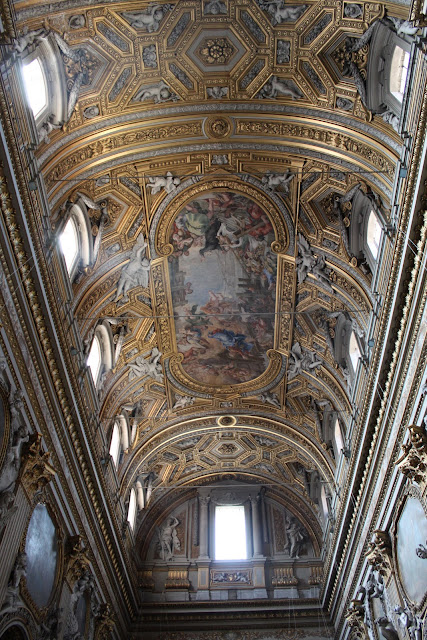
Santa Maria in Valicella, or the Chiesa Nuova. The church was built for the Congregation of the Oratorians, which was founded by San Filippo Neri in 1551. Neri is one of my favourite saints, he used to make rich men who wished to join the congregation do something humiliating before they were allowed to enter, such as walk through Rome dressed only in rags. He was also Goethe's favourite saint and in his Italian Journey he described Neri as 'The Humorous Saint". The church contains some beautiful paintings including several by Federico Barocci, which Neri apparently used to swoon in front of. It was dark in the church but here are a few photos of one of the Barocci paintings.


These last photos are from the sacristy of Santa Maria Maddelena, near the Pantheon. The decoration dates from 1738-1741. It is a sumptuous space with playful illusionistic frescoes and rich rococo furnishings that have been painted to imitate marble and are framed by asymmetrical scrolls.


Santa Maria sopra Minerva. Similar to Venice this church has a varied collection of paintings, sculpture and tombs from various centuries. However, it is different, and more typical of Rome, with it's more unified decorative program. Though unlike many of the major churches in Rome this one has a rather unexciting and heavy handed 19th century interior. The light that floods through the windows makes it beautiful nonetheless, and it also contains an array of beautiful works of art.

An impressive space, even if the 19th century blue and gold ceiling always strikes me as a bit silly.

I practiced capturing light and shade on some chairs.


Statue of Pope Urban VII in the Cappella dell'Annunziata Pope for 13 days in 1590.

Statue of St John the Baptist, the sculpture itself is not particularly stunning, but when the lights hits it the effect is quite dramatic.

And again from below.

Michelangelo's 'Christ bearing the cross' 1519.
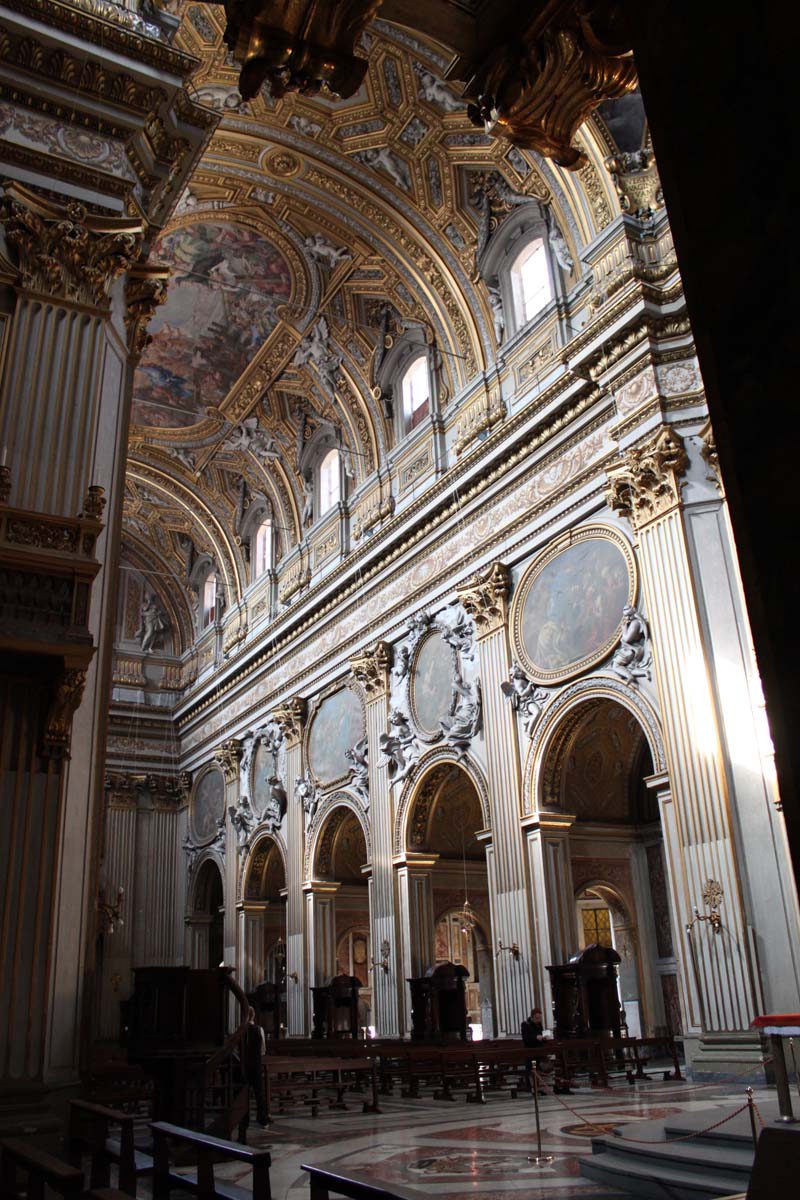

Santa Maria in Valicella, or the Chiesa Nuova. The church was built for the Congregation of the Oratorians, which was founded by San Filippo Neri in 1551. Neri is one of my favourite saints, he used to make rich men who wished to join the congregation do something humiliating before they were allowed to enter, such as walk through Rome dressed only in rags. He was also Goethe's favourite saint and in his Italian Journey he described Neri as 'The Humorous Saint". The church contains some beautiful paintings including several by Federico Barocci, which Neri apparently used to swoon in front of. It was dark in the church but here are a few photos of one of the Barocci paintings.

Barocci, 'The Visitation', 1583-6.

Hello Donkey! Barocci's colours are truly amazing. It is always a little sad that many of his finest paintings are in chapels and therefore not very well lit. At the same time if you take the time to wait for them to emerge from the darkness and observe the way the candlelight or reflected sunlight pick out certain details you perhaps a more engaging experience and something closer to the original sixteenth century one that you would in a brightly lit gallery.

Always a favourite, San Carlo alle Quattro Fontane. I absolutely fell in love with the architecture of Borromini when I first visited Rome. It is almost impossible to photograph the architecture the way you want to, but at the same time the photos you do take are usually immensely engaging with the play of straight and curved forms banging against the strict square border of the photo. What you do miss is following the way that the architectural elements flow into one another.


These last photos are from the sacristy of Santa Maria Maddelena, near the Pantheon. The decoration dates from 1738-1741. It is a sumptuous space with playful illusionistic frescoes and rich rococo furnishings that have been painted to imitate marble and are framed by asymmetrical scrolls.


'Fake' windows painted to match the real windows opposite.

The ceiling is by Girolamo Pesci. The figures are rather large and slightly heavy in comparison to the very skillfully rendered architecture. One expects to see figures more in the style of Tiepolo, but perhaps it was necessary to imbue the space with a certain amount of gravitas and seriousness and devote appropriate space to the Virgin and other religious figures.

Friday, July 9, 2010
Snapshot, Abbotsford
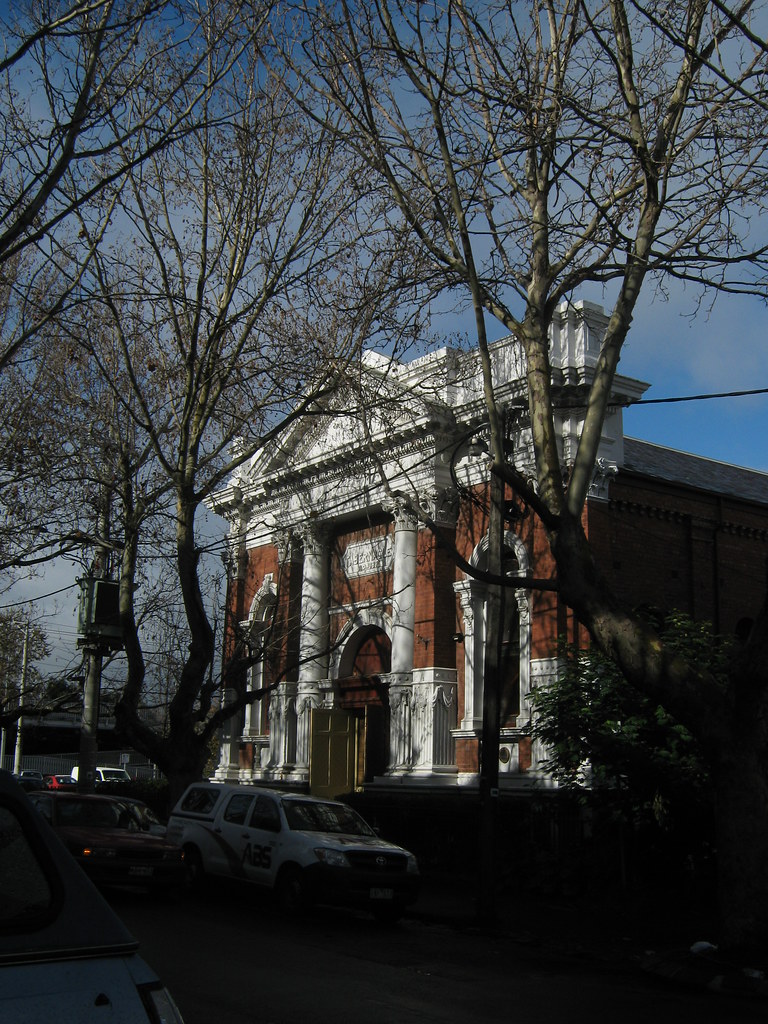
Carringbush Library. Formerly Church of Christ, built 1888-9. Architect - Jonathon Rankine.
I 'found' this a few Saturday's ago. It is just off Hoddle St, opposite the side of the town hall, but I so rarely actually walk along Hoddle that I had never noticed it before. The rays of sun sparkling on the white decoration made it extra noticeable.


I 'found' this a few Saturday's ago. It is just off Hoddle St, opposite the side of the town hall, but I so rarely actually walk along Hoddle that I had never noticed it before. The rays of sun sparkling on the white decoration made it extra noticeable.


Saturday, June 26, 2010
Some church interiors from Venice.
I was (am) still very much getting the hang of my DSLR (Canon EOS 500D if you are interested in those kinda specs). I had a ye olde film SLR for years but it was pinched from me on a trip back in 2008 and I haven't been able to replace it (btw if anyone has and wants to sell me a film Nikon f50 let me know!) This meant I was very out of practice with even the basic shutter speed and aperture combo, not to mention the array of new settings to play with like changing the ISO and white balance and a whole host of other things that make graphs that I don't really understand yet. The DSLR is great because you get very instant feedback, first on the little screen and then on your computer. For a while I just adjusted the shutter speed and let the camera choose the aperture, or vice versa. But I wasn't all that happy with the results, I often felt they were over exposed. I have always had a fondness for dramatic contrasts of light and shade, chiaroscuro I suppose, photos but the basic settings for the camera seem to err on the side of overall even exposure. There is probably a way to change this but I haven't figured it out yet. I'm not really a manual reading person I just like to play around and gradually figure things out. Also I find the manuals are so full of cheesy photos of cutesy children and cliche landscapes that they start to put me off taking any photos.
One thing I really struggled with was working out how to take decent photos inside churches. This was actually one of the things I was looking forward to being able to do with a better camera. Generally they are very low light and I had never taken that many in the past with my little camera unless there was somewhere I could rest it (this resulted in many many photos taken from 'pew height'). Taking photos inside churches in Venice was also compounded by their ridiculous rules against taking photos. I understand rules against flash and rules against photos in churches or chapels that are largely used for devotion, or during services and so on. However, most churches are essentially being used as tourist attractions and I think as long as people aren't lying across pews or getting in the way they should be allowed to take photos. I also think that frankly the 'custode' yelling 'NO FOTO' across a silent church is far more disruptive.
I had mixed results with my photos, in quite a few churches I just set the camera to auto with no flash and 'shot from the hip', in others I hid behind a column or waited till I wasn't under surveillance. It is frustrating but maybe it made me more creative and more focused on small details.
Here are some of my favourites:


Santa Maria Formosa
Or Santa Maria Samosa as I like to call it.It has an interesting interior, lots of pierced walls, satisfying late 15th century architectural geometry. I actually can't decide whether it is complex or simple, perhaps it is both if that is possible. It has straight lines and simple curves yet they are put together in such a way as to create a very satisfying whole where your eye can't quite settle on one point.


I have some Roman interiors too but perhaps I should start a new post!
One thing I really struggled with was working out how to take decent photos inside churches. This was actually one of the things I was looking forward to being able to do with a better camera. Generally they are very low light and I had never taken that many in the past with my little camera unless there was somewhere I could rest it (this resulted in many many photos taken from 'pew height'). Taking photos inside churches in Venice was also compounded by their ridiculous rules against taking photos. I understand rules against flash and rules against photos in churches or chapels that are largely used for devotion, or during services and so on. However, most churches are essentially being used as tourist attractions and I think as long as people aren't lying across pews or getting in the way they should be allowed to take photos. I also think that frankly the 'custode' yelling 'NO FOTO' across a silent church is far more disruptive.
I had mixed results with my photos, in quite a few churches I just set the camera to auto with no flash and 'shot from the hip', in others I hid behind a column or waited till I wasn't under surveillance. It is frustrating but maybe it made me more creative and more focused on small details.
Here are some of my favourites:
Santa Maria dei Miracoli. This church is small and exquisite. The marble clad interior is quite unusual for Venice where many churches have brick walls and the interior decoration seems a bit haphazard to someone more accustomed to the interiors typical of Baroque Rome. The delicate carvings are very beautiful and I became quite obsessed with them in this church and others and took many many photos.


Marble paving is nothing without beams of natural sunlight to illuminate it.

The obligatory Jesus.

Santa Maria Formosa
Or Santa Maria Samosa as I like to call it.It has an interesting interior, lots of pierced walls, satisfying late 15th century architectural geometry. I actually can't decide whether it is complex or simple, perhaps it is both if that is possible. It has straight lines and simple curves yet they are put together in such a way as to create a very satisfying whole where your eye can't quite settle on one point.

Below are some of the bare brick walls I mentioned before, and the unusual pierced walls of the side chapels. Usually side chapels are quite enclosed. The stark white walls are outlined with stone carvings that up close are often very delicate with marble columns that usually don't quite match on account of them being salvaged from other buildings. 

San Giovanni e Paolo (or San Zanipolo as the Venetians say)
This is one of the largest churches in Venice. I most like all the wall tombs and the huge columns.

A lot of writer's post Ruskin tend to have a go at the 17th and 18th century additions to these churches, as though they somehow besmirch the perfect 13th/14th/15th century origins. I find it quite annoying for various reasons but mainly because the beauty of these churches is the crazy mix of different works of art and architecture from different periods. It is an artistic and a social history.

Wall tomb.

The high altar

Hello baby face.

Candles at Santo Stefano


I have some Roman interiors too but perhaps I should start a new post!
Sunday, June 6, 2010
Snapshot, Venice
I am busy sorting photos for a longer post but I noticed this picture I had forgotten about.


Friday, June 4, 2010
Snapshots, Venice
I have been home a month and I am being very slack about pictures of Venice! I wish I could blame some kind of super busy lifestyle but really it is more a type of blogging ennui, and battles with my recently installed photoshop. I have added blogging to my list for the weekend and hopefully this is the first of a few photo posts from my trip. This is a view of the underneath of the Rialto Bridge. I was struck by the thin shaft of sunlight that was breaking through a narrow canal that runs into the Grand canal. Very pretty. Also I took this photo before 9am, it is well worth getting up and out in Venice by 8am or earlier as most tourists don't seem to emerge till after 10am.

Saturday, May 8, 2010

Monday, April 5, 2010
Snapshot Venice, 2005.
I'm off to Venice, hope to have lots of gorgeous photos for the blog when I get back from my trip, and maybe even a sneaky update while I'm away. Though I can't promise I will spend my time seeking out internet cafes when there are Veronese and Titian paintings to see, canals to cross and prosecco to drink.
A presto!

A presto!

Friday, March 26, 2010
Save the Windsor Rally

I was at the rally yesterday and there was a decent turn out. I'm terrible at guessing crowd numbers but maybe 150 people? Enough to fill the steps and crowd the pavement. Rod Quantock MC'ed, and various people spoke including Bob Brown. Who promised to make it a national issue. I also hope that The Greens make it an election issue. They came very close to winning the seat of Melbourne in the last election and I hope that if they could campaign on issues like this then maybe they would unseat Bronwyn Pike. Some of the liberal members also spoke but I am a bit cynical about their motivations, they were more focused on the corruption in the planning process and one man in particular seemed to be very obviously avoiding stating that he was against the proposal for The Windsor.

I am very against for a few reasons. I believe that a huge tower tacked on the back of The Windsor will ruin its appearance, the way the the sun shimmers over its facade will be lost and the grand hotel will sit uncomfortably in the shadow of a glass monolith. I think the design itself is boring and completely insensitive to The Windsor, it speaks of an architect who wants to dominate a low rise area with a statement building, not try and work sensitively with what is already there. The issue here is not simply about a single building but about good urban planning, about how buildings sit in relation to one another. Tall buildings in Melbourne's grid plan create wind tunnels and shade streets for much of the day. Lonsdale St beside the QV is a good example, the BHP billiton building funnels the wind along the street and keeps the street cafes in shade almost all day. It's all a bit depressing. Melbourne has places for high rise buildings, like docklands and Southbank and the other end of the CBD, we need to retain low rise areas as well. Many cities have very successfully kept strict height limits, and these have led to very creative and inventive pieces of architecture. Anyway here are some pictures, I particularly like my one of the Madden Mad Hatter towering over the Windsor so I have made a new badge to replace my now defunct Save Lonsdale House Badge.


The relevance of the Alice in Wonderland characters is that Madden is the Mad Hatter (naturally). Brumby is the March Hare and Heritage Victoria is the Dormouse, asleep at the table. Alice represented the public, confused and treated with contempt.

Subscribe to:
Posts (Atom)
