
I haven't been to an open garden in ages. I love them, I love poking around other people's gardens, usually feeling envious because I don't have a garden (although I did hear an auctioneer yesterday describing my nearby Fitzroy gardens as Melbourne's answer to Central Park or the Luxembourg Gardens, slightly hyperbolic but having them nearby does sometimes feel like having a huge backyard that someone else looks after).
Now I am tempted to visit more of them. I am a bit transport challenged on account of not having a car but I noticed there is one in Domain Rd, South Yarra next weekend so I might schlep to that. You can find a short list of upcoming gardens on the website - http://www.opengarden.org.au/index.html
I do find ti odd that the only full list is in the book, which you have to buy. Considering we pay to go into the gardens I feel this is a bit unnecessary. I wonder if it is a deliberate decision to try and sell the book or whether they just haven't thought to have a full online list. Also I would prefer to be able to buy (maybe at a cheaper price) a pdf of the book, as it is essentially useless after the season has finished.
The two gardens I visited yesterday were the Adams and Ford gardens. They are adjacent blocks in Eltham. The landscape design of both was mainly the work of Gordon Ford. He bought the land in 1945, it used to be an orchard. Ford used to work with Ellis Stones, who created much of the stone work for the gardens designed by Edna Walling. You can see some aspects that have been derived from Edna Walling's designs but overall the garden has an even softer structure. The stone work is mostly aiming to look natural, or is almost invisible beneath plantings. My first impression of the Ford garden was that it was quite open and almost sparsely planted, you can easily see through to the garden to the neighbouring houses. The short write up did say that a lot of plants, including trees, had been lost over the last few, hot, summers. That said, as we explored the garden I kept discovering new small spaces that were hidden behind the house or behind thicker plantings. The main feature was a large pool of water fed by a small rocky waterfall. Above this I discovered some large stepping stones across a pool, which apparently used to be the only way to reach the house from the street.
Photos of the Ford Garden.

The lower pool.

A view of the pond from the opposite direction.

The stepping stone entrance.

The Waterfall
 The house, mud brick of course, what else would you expect in Eltham?!


One of the small spaces that I 'discovered'. I can imagine myself drinking tea/gin and tonics here in the sun and reading.


A narrow path, I like a lot of height in a a garden and paths that are very enclosed so that when you emerge in a new space it feels like a surprise. It makes wandering around a garden seem like more of an adventure and I think this is a god example of how it can be done on a smallish scale.

Chairs

Head in a pot, maybe to remind the children to behave, or something.


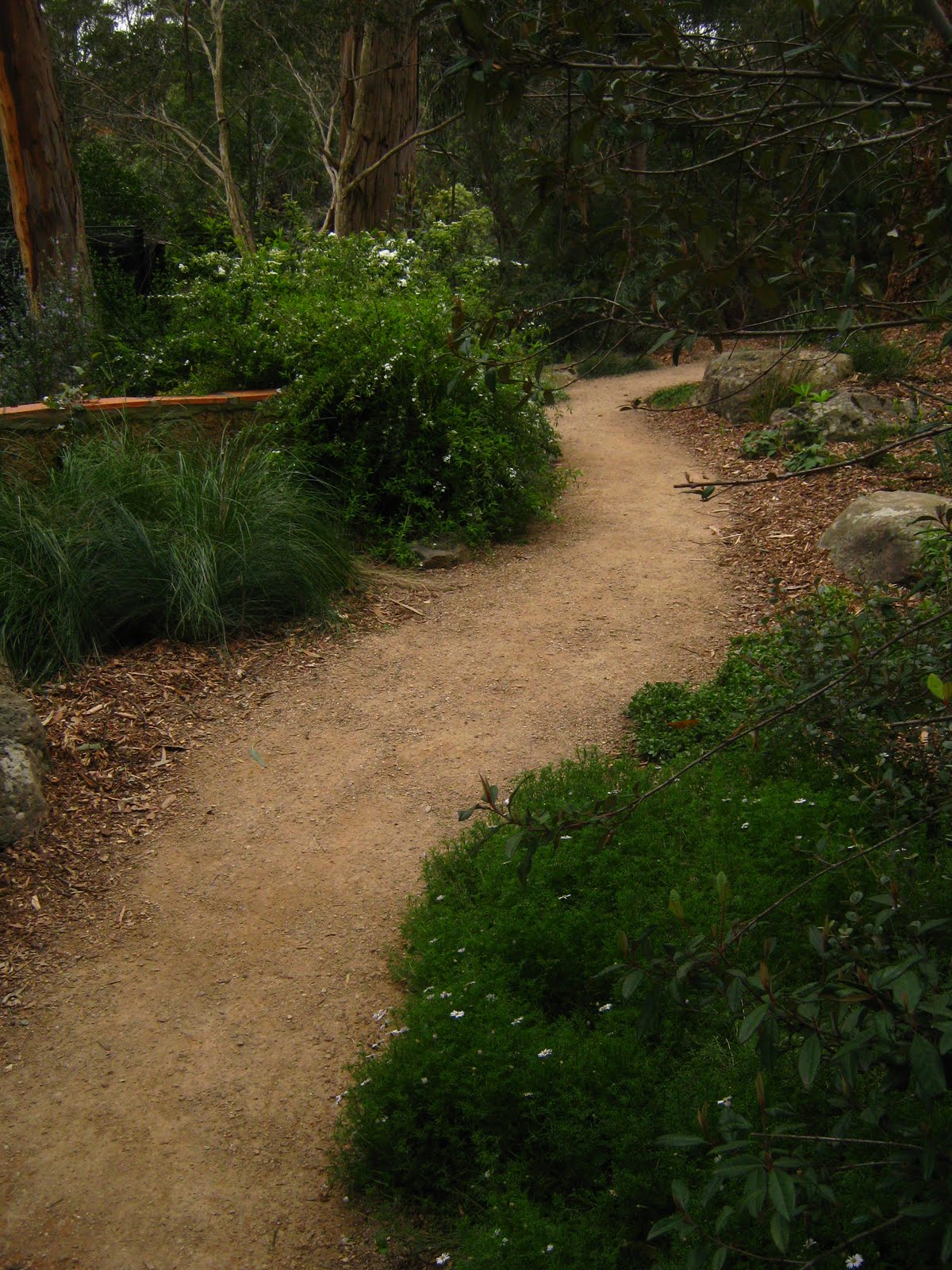
The photos below are of the second garden, which was more-or-less designed by the same person from the late seventies. The house in particular has the look of a certain era about it, but not in a bad, dated way.




This is the more recent swimming pool and rock garden. Pretty impressive and a nice way to have a swimming pool, which actually adds to the look of the garden rather than detracts. Though I bet it would be a pain to clean with all those eucalypts around.


