

Showing posts with label Churches. Show all posts
Showing posts with label Churches. Show all posts
Saturday, January 21, 2012
Snapshot, St Patrick's Cathedral from Parliament Gardens
I always enjoy when you spot a piece of architecture from a new angle and through a new frame.


Thursday, November 4, 2010
Decorative details - Venetian Doorway
A doorway from Santa Maria Gloriosa dei Frari in Venice. A nice door if I ever saw one...


Sunday, July 18, 2010
Church interiors Rome
A follow on to my Venice post. By the time I got to Rome I was feeling a bit more confident with my camera and I played around with the settings a bit more. Also, because generally no one cares if you take lots of photos inside a Roman church I was able to put the camera on manual and experiment a bit more. I found once I trusted my own instincts I was actually able to capture some of the contrast between dark and light that you get in churches, for instance where beams of sunlight hit a column or a sculpture. Though I probably need a tripod to properly capture some images.
Santa Maria sopra Minerva. Similar to Venice this church has a varied collection of paintings, sculpture and tombs from various centuries. However, it is different, and more typical of Rome, with it's more unified decorative program. Though unlike many of the major churches in Rome this one has a rather unexciting and heavy handed 19th century interior. The light that floods through the windows makes it beautiful nonetheless, and it also contains an array of beautiful works of art.


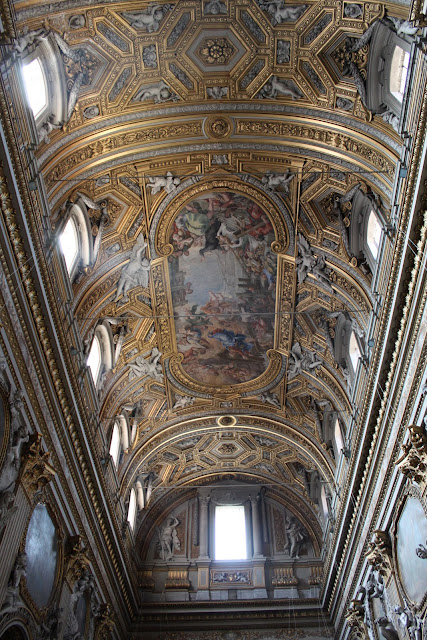
Santa Maria in Valicella, or the Chiesa Nuova. The church was built for the Congregation of the Oratorians, which was founded by San Filippo Neri in 1551. Neri is one of my favourite saints, he used to make rich men who wished to join the congregation do something humiliating before they were allowed to enter, such as walk through Rome dressed only in rags. He was also Goethe's favourite saint and in his Italian Journey he described Neri as 'The Humorous Saint". The church contains some beautiful paintings including several by Federico Barocci, which Neri apparently used to swoon in front of. It was dark in the church but here are a few photos of one of the Barocci paintings.


These last photos are from the sacristy of Santa Maria Maddelena, near the Pantheon. The decoration dates from 1738-1741. It is a sumptuous space with playful illusionistic frescoes and rich rococo furnishings that have been painted to imitate marble and are framed by asymmetrical scrolls.


Santa Maria sopra Minerva. Similar to Venice this church has a varied collection of paintings, sculpture and tombs from various centuries. However, it is different, and more typical of Rome, with it's more unified decorative program. Though unlike many of the major churches in Rome this one has a rather unexciting and heavy handed 19th century interior. The light that floods through the windows makes it beautiful nonetheless, and it also contains an array of beautiful works of art.

An impressive space, even if the 19th century blue and gold ceiling always strikes me as a bit silly.

I practiced capturing light and shade on some chairs.


Statue of Pope Urban VII in the Cappella dell'Annunziata Pope for 13 days in 1590.

Statue of St John the Baptist, the sculpture itself is not particularly stunning, but when the lights hits it the effect is quite dramatic.

And again from below.

Michelangelo's 'Christ bearing the cross' 1519.
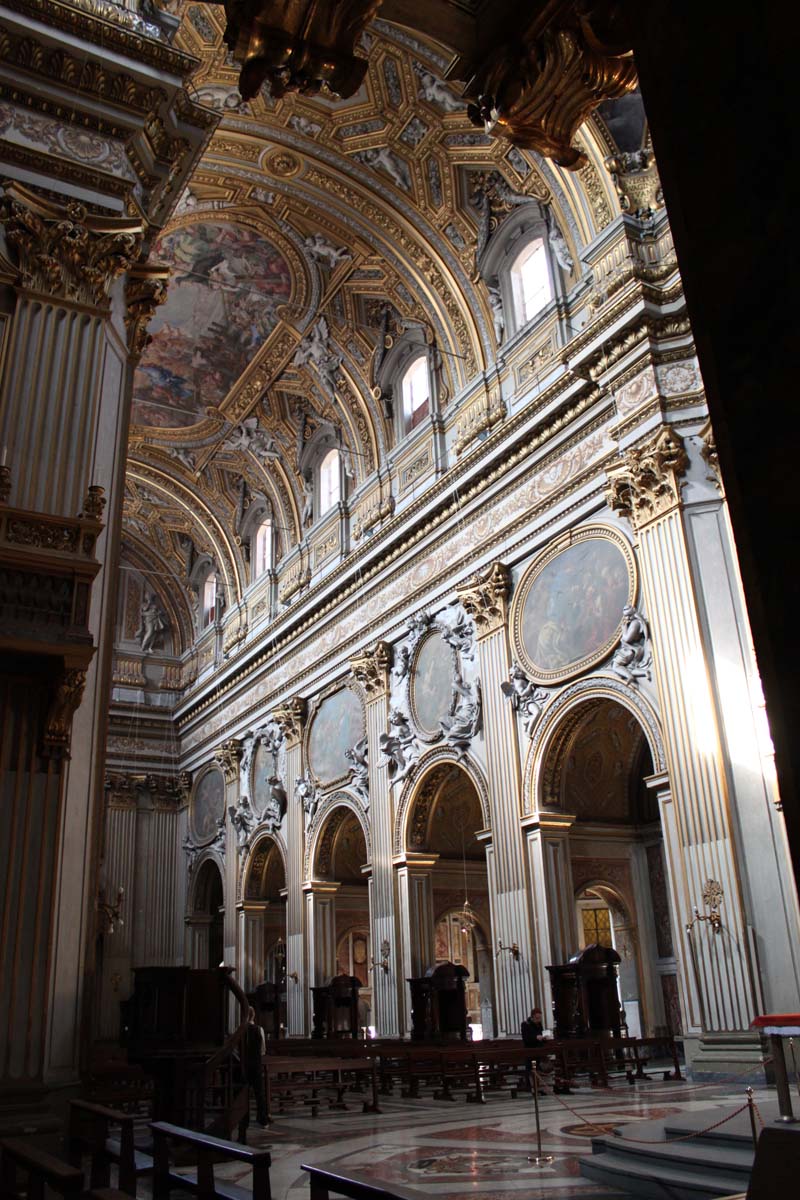

Santa Maria in Valicella, or the Chiesa Nuova. The church was built for the Congregation of the Oratorians, which was founded by San Filippo Neri in 1551. Neri is one of my favourite saints, he used to make rich men who wished to join the congregation do something humiliating before they were allowed to enter, such as walk through Rome dressed only in rags. He was also Goethe's favourite saint and in his Italian Journey he described Neri as 'The Humorous Saint". The church contains some beautiful paintings including several by Federico Barocci, which Neri apparently used to swoon in front of. It was dark in the church but here are a few photos of one of the Barocci paintings.

Barocci, 'The Visitation', 1583-6.

Hello Donkey! Barocci's colours are truly amazing. It is always a little sad that many of his finest paintings are in chapels and therefore not very well lit. At the same time if you take the time to wait for them to emerge from the darkness and observe the way the candlelight or reflected sunlight pick out certain details you perhaps a more engaging experience and something closer to the original sixteenth century one that you would in a brightly lit gallery.

Always a favourite, San Carlo alle Quattro Fontane. I absolutely fell in love with the architecture of Borromini when I first visited Rome. It is almost impossible to photograph the architecture the way you want to, but at the same time the photos you do take are usually immensely engaging with the play of straight and curved forms banging against the strict square border of the photo. What you do miss is following the way that the architectural elements flow into one another.


These last photos are from the sacristy of Santa Maria Maddelena, near the Pantheon. The decoration dates from 1738-1741. It is a sumptuous space with playful illusionistic frescoes and rich rococo furnishings that have been painted to imitate marble and are framed by asymmetrical scrolls.


'Fake' windows painted to match the real windows opposite.

The ceiling is by Girolamo Pesci. The figures are rather large and slightly heavy in comparison to the very skillfully rendered architecture. One expects to see figures more in the style of Tiepolo, but perhaps it was necessary to imbue the space with a certain amount of gravitas and seriousness and devote appropriate space to the Virgin and other religious figures.

Saturday, June 26, 2010
Some church interiors from Venice.
I was (am) still very much getting the hang of my DSLR (Canon EOS 500D if you are interested in those kinda specs). I had a ye olde film SLR for years but it was pinched from me on a trip back in 2008 and I haven't been able to replace it (btw if anyone has and wants to sell me a film Nikon f50 let me know!) This meant I was very out of practice with even the basic shutter speed and aperture combo, not to mention the array of new settings to play with like changing the ISO and white balance and a whole host of other things that make graphs that I don't really understand yet. The DSLR is great because you get very instant feedback, first on the little screen and then on your computer. For a while I just adjusted the shutter speed and let the camera choose the aperture, or vice versa. But I wasn't all that happy with the results, I often felt they were over exposed. I have always had a fondness for dramatic contrasts of light and shade, chiaroscuro I suppose, photos but the basic settings for the camera seem to err on the side of overall even exposure. There is probably a way to change this but I haven't figured it out yet. I'm not really a manual reading person I just like to play around and gradually figure things out. Also I find the manuals are so full of cheesy photos of cutesy children and cliche landscapes that they start to put me off taking any photos.
One thing I really struggled with was working out how to take decent photos inside churches. This was actually one of the things I was looking forward to being able to do with a better camera. Generally they are very low light and I had never taken that many in the past with my little camera unless there was somewhere I could rest it (this resulted in many many photos taken from 'pew height'). Taking photos inside churches in Venice was also compounded by their ridiculous rules against taking photos. I understand rules against flash and rules against photos in churches or chapels that are largely used for devotion, or during services and so on. However, most churches are essentially being used as tourist attractions and I think as long as people aren't lying across pews or getting in the way they should be allowed to take photos. I also think that frankly the 'custode' yelling 'NO FOTO' across a silent church is far more disruptive.
I had mixed results with my photos, in quite a few churches I just set the camera to auto with no flash and 'shot from the hip', in others I hid behind a column or waited till I wasn't under surveillance. It is frustrating but maybe it made me more creative and more focused on small details.
Here are some of my favourites:


Santa Maria Formosa
Or Santa Maria Samosa as I like to call it.It has an interesting interior, lots of pierced walls, satisfying late 15th century architectural geometry. I actually can't decide whether it is complex or simple, perhaps it is both if that is possible. It has straight lines and simple curves yet they are put together in such a way as to create a very satisfying whole where your eye can't quite settle on one point.


I have some Roman interiors too but perhaps I should start a new post!
One thing I really struggled with was working out how to take decent photos inside churches. This was actually one of the things I was looking forward to being able to do with a better camera. Generally they are very low light and I had never taken that many in the past with my little camera unless there was somewhere I could rest it (this resulted in many many photos taken from 'pew height'). Taking photos inside churches in Venice was also compounded by their ridiculous rules against taking photos. I understand rules against flash and rules against photos in churches or chapels that are largely used for devotion, or during services and so on. However, most churches are essentially being used as tourist attractions and I think as long as people aren't lying across pews or getting in the way they should be allowed to take photos. I also think that frankly the 'custode' yelling 'NO FOTO' across a silent church is far more disruptive.
I had mixed results with my photos, in quite a few churches I just set the camera to auto with no flash and 'shot from the hip', in others I hid behind a column or waited till I wasn't under surveillance. It is frustrating but maybe it made me more creative and more focused on small details.
Here are some of my favourites:
Santa Maria dei Miracoli. This church is small and exquisite. The marble clad interior is quite unusual for Venice where many churches have brick walls and the interior decoration seems a bit haphazard to someone more accustomed to the interiors typical of Baroque Rome. The delicate carvings are very beautiful and I became quite obsessed with them in this church and others and took many many photos.


Marble paving is nothing without beams of natural sunlight to illuminate it.

The obligatory Jesus.

Santa Maria Formosa
Or Santa Maria Samosa as I like to call it.It has an interesting interior, lots of pierced walls, satisfying late 15th century architectural geometry. I actually can't decide whether it is complex or simple, perhaps it is both if that is possible. It has straight lines and simple curves yet they are put together in such a way as to create a very satisfying whole where your eye can't quite settle on one point.

Below are some of the bare brick walls I mentioned before, and the unusual pierced walls of the side chapels. Usually side chapels are quite enclosed. The stark white walls are outlined with stone carvings that up close are often very delicate with marble columns that usually don't quite match on account of them being salvaged from other buildings. 

San Giovanni e Paolo (or San Zanipolo as the Venetians say)
This is one of the largest churches in Venice. I most like all the wall tombs and the huge columns.

A lot of writer's post Ruskin tend to have a go at the 17th and 18th century additions to these churches, as though they somehow besmirch the perfect 13th/14th/15th century origins. I find it quite annoying for various reasons but mainly because the beauty of these churches is the crazy mix of different works of art and architecture from different periods. It is an artistic and a social history.

Wall tomb.

The high altar

Hello baby face.

Candles at Santo Stefano


I have some Roman interiors too but perhaps I should start a new post!
Saturday, May 8, 2010

Monday, November 2, 2009


Wednesday, August 26, 2009
Snapshot, Melbourne University.
Another Melbourne Uni building, the chapel at Newman College to be exact. Another building I walk past so often I almost don't see it any more. It is pretty wonderful, I have been to several concerts inside and it has great acoustics. Even though it is in a Gothic style it still has a very mid-twentieth century feel to it. The clean lines and massed stone, a very modern re-interpretation of Gothic. Its large almost rectangular mass and the way it stands apart from the other college buildings reminds me of the Sydney War Memorial in Hyde Park. It was designed by the architects Connelly, Dale and T. Payne and consecrated in 1942, over twenty years after the college by Walter Burley Griffin and Marion Mahony Griffin had been completed.


Friday, July 10, 2009
Snapshot, East Melbourne
Some photos taken on the beautiful sunny winter's day on Tuesday. Possibly spent a little too much time photographing East Melbourne.


Sunday, April 12, 2009
Snapshots East Melbourne/Collingwood
Was out wandering in the late afternoon sun today and took some photos.

Clarendon Terrace, Clarendon St. Built in 1857 and nearly demolished in the 1970s. Beautiful building now the headquarters of the Menzies Foundation.

A small church on Oxford St, Collingwood. I was intrigued by it, the sun ghad caught the upper half of its facade so it stood out. I have done some quick research and found a bit of its history.
Originally it was an Anglican church, the only original Anglican church still standing in Collingwood. It was built in 1875 as St Saviours Mission church (such a late nineteenth century name!) founded in aprt in protest that another Anglican church, St Phillips, was charging for use of its pews. It had with street preaching and temperance meetings. It cost three thousand pounds to construct and was comissioned by an influential layman, Charles Baker. It was made of local Collingwood bluestone and was consecrated on 19th December 1880. More here.
Subsequently bought in 1954 by the Russian Orthodox Church and reconsecrated as the russian Orthodox Cathedral Church of the Protection of the Holy Virgin. Not sure when it was built but looks late nineteenth century. Found the info about the sale in this thesis by Michael Alex Protopopov.
 An early engraving of the building from the State Library, info here. I'm not sure on the angle, I wish I had had a more careful look now! Will have to go and look again, if this is the facade I photographed (the bell tower and rose window certainly match) it has changed a little, the windows shortened and a door put in, and that side building is gone. Hmmm.
Subscribe to:
Posts (Atom)
