

Sunday, March 7, 2010
Snapshot, Sydney


Monday, March 1, 2010
'Garters and Petticoats' - Portraits of Victoria and Albert
A talk coming up at Melbourne Uni that might interest some of my readers.

Click the image to see the full size poster. You can also view the original post here: http://fineartsnetwork.org.au
I should say that I help run the fine arts network website and I recommend it to you if you have an interest in art history. It includes details of art history events (focused on Melbourne), new research databases, funding, conferences and journals.

Click the image to see the full size poster. You can also view the original post here: http://fineartsnetwork.org.au
I should say that I help run the fine arts network website and I recommend it to you if you have an interest in art history. It includes details of art history events (focused on Melbourne), new research databases, funding, conferences and journals.
Monday, February 22, 2010
Fitzroy Snapshot
The old Ace Billiards factory on Charles Street, now apartments. Not sure if it was always a Billiard Table factory or not. Anyone know?


Saturday, February 20, 2010
Alfonso Parigi set designs
More sets I'm working on and thought I would share. These set designs are by Alfonso Parigi for the opera Le Nozze degli Dei (The Marriage of the Gods). It was performed in 1637 in Florence at the Palazzo Pitti in the courtyard. The images are from the British Museum website.


Tuesday, February 16, 2010
Hard at work with Ludovico Burnacini, 17th century set designer
I am busy working away on the last section of one of my chapters. It is about Ludovico Burnacini's (Mantua 1636 - Vienna 1707) set designs for the festa teatrlae (theatrical opera and ballet) called Il Pomo d'Oro (The Golden Apple). It was performed in Vienna to celebrate the marriage of Emperor Leopold I to the Infanta Margherita of Spain. I was flicking through my photos of the sets and found several I had taken in the Biblioteca Livia Simone (the library section of the Museo della Teatro della Scala). The library itself was an interesting experience, housed on the top floor of a palazzo that was otherwise used as an auction house. I was the only person using the library and the head librarian would escort me through the store rooms of the auction house (think paintings with gold leaf rococo frames stacked against walls, various marble busts of notable persons and piles of 18th century carved walking sticks). Upstairs it was all very utilitarian and I sat at a simple table flicking through the libretti (literally small books) that contained engravings and texts of 17th and 18th century operas. When I wanted something I would have to go and knock at the door of the librarian who was listening to very loud opera (naturally) and photographing piles of huge marionette puppets from the 19th century. Anyway the photos are good as they give an impression of the small size of these books.
The opera/ballet was very spectacular. Burnacini first had to build and decorate the theatre (this took several years) and it some sources suggest it sat 5000 spectators, though this may be an exaggeration. There were twenty three sets and a variety of special effects to create storms, earthquakes, fire breathing dragons, thunder and lightening. The sets were engraved and distributed widely across Europe. Burnacini's sets are typical of the late seventeenth-century. The sets have a focus on one point perspective that creates the illusion of far distant perspective that disappears into the background.


The opera/ballet was very spectacular. Burnacini first had to build and decorate the theatre (this took several years) and it some sources suggest it sat 5000 spectators, though this may be an exaggeration. There were twenty three sets and a variety of special effects to create storms, earthquakes, fire breathing dragons, thunder and lightening. The sets were engraved and distributed widely across Europe. Burnacini's sets are typical of the late seventeenth-century. The sets have a focus on one point perspective that creates the illusion of far distant perspective that disappears into the background.

The title page and some of the list of scene changes.


Woodland scenes, even wild nature was symmetrical and ordered.

Note the repetition of the same architectural form to create an exaggerated perspective.

A garden scene, although the symmetry and architectural structure is exaggerated, it is not dissimilar to the actual gardens of the period.


A cave and a rocky landscape, both common settings in Baroque opera, in part because set designers and librettists often aimed to represent the four elements (earth, fire, water, air) and the whole range of earthly and heavenly realms in each production.


Set designers were usually also architects and the designs they made for the stage allowed them to have free reign on their imaginations and create elaborate and fantastical buildings and interiors that were not possible in the real world.

The storm scene, another favourite setting, usually marked in the narrative by the hero having to make a difficult decision. Also a chance to show off elaborate special effects that created lightening and thunder and even real rain on occasion.


A few more settings with elaborate architecture.
Friday, February 12, 2010
Thames Town
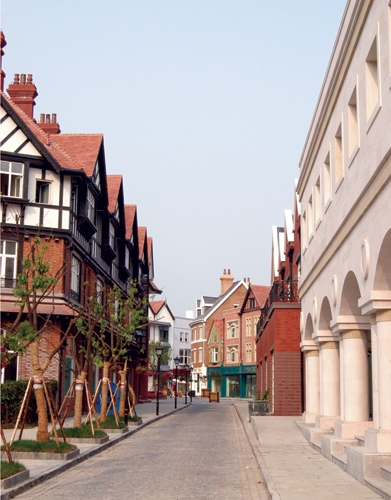 View of Thames Town (from www.building.co.uk )
from www.thamestown.com
This strange town is just oustide Shanghai in China. It is a replica of an English Town. So strange. the website describes it as 'Authentic English Town'. It looks like a film set, old, yet not. I wonder what the buildings are like, are they all created from brick, sandstone, marble and so on or are they more cheaply constructed?This video shows a good range of views of the town.
I first saw Thames Town on that Paul Merton documentary on China that screened on the ABC recently (if your quick the last episode with Thames Town in it is still on iView). Apparently almost all the houses are sold but very few are actually lived in.
The illusion, such as it is, would appear to crumble a little at the edges.

I find places like this so intriguing. Thames town reminds me of several places. the film sets I visited at Cinecitta in Italy, the reconstructed town centre of Warsaw and even the odd but delightful Italianate town of Portmeirion in Wales built by the eccentric Clough Williams Ellis. All places I should do a post on at some point. Do you know any other slightly surreal towns that look like film sets or at least an architectural duck out of water?
Tuesday, February 2, 2010
Snapshots - Kyneton
 Cast iron verandah on Mollison St.
I stopped in Kyneton briefly on Saturday. I don't think I had ever been there before, as far as I can remember. There are some lovely old buildings, particularly on Piper St.
 The Mechanics Institute, built in 1858 to a design by William Douglas.
 The old flour mill on Piper St, now a curry house and wine bar.
Sunday, January 24, 2010
Roses and wire fences

I saw this garden in Daylesford. The bright colour of the roses stood out against the dry brown grass and the plain wire fence. There was something very suburban summer about it all. I often find roses an odd choice for front and centre in a garden as they spend so much of the year looking like spiky sticks. They are beautiful when they come out though, so maybe it's all worth it.

Also if you have a love for ogling other people's gardens you must visit Faux Fuchsia's blog and see the FF garden.

Daylesford Snapshot
 Summer in Daylesford. Flowers everywhere. This weatherboard house caught my eye, the blue almost matched the sky, the rust red roof, even the old grey wooden fence somehow balances the view.
Friday, January 15, 2010
Demolition has begun on Lonsdale House and Caldeonian Lane

I was deeply saddened yesterday to walk past Caledonian Lane and find it blocked off. Pieces were being hacked off the buildings in Caledonian Lane. For now the façade of Lonsdale House is intact but for how long I don't know. Sources suggest that scaffolding will soon be erected.

A protest is planned for tonight at 6pm.
The demolition of Lonsdale House and Caledonian Lane has begun.
Protest this evening (Friday 15th January) at 6pm.
Come to Lonsdale House this evening and show your anger at Myer, the State Government and the City of Melbourne for allowing the destruction of our architectural heritage.
Please bring friends and pass this message along, we need as many people as possible.

Subscribe to:
Posts (Atom)
